



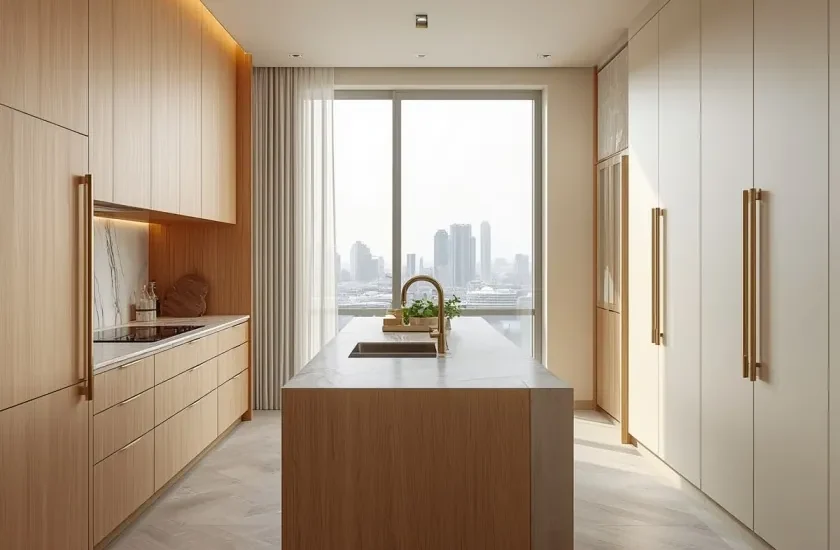
Choosing between solid wood and MDF in Dubai’s climate is not the same decision it would be in a mild, stable environment. Between 45–50°C summer heat, coastal humidity that can climb past 80%, salt-laden air near the Marina and Palm, and interiors that swing from cold, dry air conditioning to hot, damp conditions the moment the AC switches off, the material behind your cabinets and furniture matters far more than the finish on top of it. Pick the wrong one for the wrong room and you’ll see warped doors, swollen cabinet edges, or gaps at the joints within a year or two. This guide breaks down exactly how each material behaves here — and where each one genuinely belongs in a Dubai home.
Why Dubai’s Climate Changes the Solid Wood vs MDF Decision
The enemy of every wooden material in the UAE is moisture movement, not just moisture itself. Timber is hygroscopic — it constantly absorbs and releases water vapour as humidity rises and falls. Dubai’s daily cycle of humid outdoor air and dry, chilled indoor air puts wood through repeated expansion and contraction. Add the coastal salt content that degrades finishes and fittings, plus fine dust that abrades surfaces, and you have conditions that punish anything that wasn’t specified and built for the region. The right choice comes down to how much moisture a piece will face, how it’s finished, and how well the raw material was prepared before it ever reached your home.
How Solid Wood Performs in Dubai’s Heat and Humidity
Solid wood is the premium, long-life option — but only when it’s the right species, properly kiln-dried, and acclimatised on-site before installation. Its biggest strength is longevity and repairability: a solid wood dining table or kitchen island can be sanded back and refinished many times over decades, and it adds real resale value to a property.
Its weakness is movement. Poorly seasoned or unacclimatised timber will cup, warp, or open at the joints as it reacts to Dubai’s humidity swings. The fix is in the preparation, not the wood itself — quality kiln-dried stock, a stable moisture content, and a robust sealed finish keep movement to a minimum. Dense, oily species handle the climate best: teak and iroko are naturally moisture- and rot-resistant, which is why they’re the go-to for outdoor use, while oak and walnut suit interior furniture. Crucially, solid hardwood is the only option that can survive outdoors here — MDF cannot go outside under any circumstances.
How MDF Holds Up in Dubai — And Where It Fails
MDF (medium-density fibreboard) has a genuine advantage over solid wood in one respect: it’s dimensionally stable to ambient humidity. Because it has no grain, it won’t cup or warp with normal day-to-day humidity changes the way a solid timber panel can. Its smooth, uniform surface is ideal for a flawless painted, lacquered, or veneered finish — which is exactly why most fitted wardrobes and painted cabinet doors in Dubai are made from it. It’s also significantly cheaper and completely consistent, with no knots or defects.
The catch is liquid water. Standard MDF swells badly if water reaches an unsealed edge — around a sink, a leaking dishwasher, or a wet bathroom floor — and unlike solid wood, it does not recover. Once it swells, it stays damaged. That makes edge banding and sealing non-negotiable, and it makes material grade critical: moisture-resistant MDF (MR-MDF, often green-tinted / HMR) is engineered for kitchens and bathrooms and should always be specified for any panel near water. Two other limitations to plan for: MDF doesn’t hold screws well on its cut edges (proper fixings solve this), and long unsupported shelves can sag under heavy loads. For safety and air quality, insist on a low-emission grade (E1, E0, or CARB-compliant) so formaldehyde off-gassing stays within safe limits.
Moisture-Resistant MDF and Marine Plywood: The Smart Middle Ground
For any cabinet carcass exposed to moisture — kitchen base units, bathroom vanities, laundry areas — the strongest choice in Dubai is often neither standard material on its own. Marine or BWP-grade plywood offers excellent water resistance and holds screws far better than MDF, while MR-MDF gives you a perfectly smooth surface for painted doors and fronts. A well-built Dubai kitchen frequently combines them: a moisture-resistant ply or MR-MDF carcass with either solid wood or MDF door fronts, depending on the look and budget.
Solid Wood vs MDF Cost in Dubai (AED)
As a rough guide for custom work, MDF-based cabinetry typically runs lower per linear metre, while solid hardwood commands a clear premium for the same run — and marine ply sits in between. (Figures below are indicative only and should be confirmed with our team, as prices vary by species, grade, finish, and design complexity.)
| Material | Indicative relative cost | Best value when… |
|---|---|---|
| Standard MDF (painted/lacquered) | Lowest | Dry-area wardrobes, painted doors |
| MR-MDF / Marine plywood | Mid | Kitchens, bathrooms, wet areas |
| Solid hardwood (oak, teak, iroko) | Highest | Heirloom furniture, outdoor, refinishable surfaces |
The real comparison is lifecycle cost. Solid wood costs more upfront but can be repaired and refinished for decades; damaged MDF usually has to be replaced. Match the spend to how long the piece needs to last and how much abuse it will take.
Which Material for Which Room? A Dubai Home Guide
- Kitchen cabinets: MR-MDF or marine ply carcasses; solid wood or MDF fronts. Never standard MDF near the sink.
- Fitted wardrobes & cupboards: MDF is excellent for smooth painted or lacquered finishes in dry bedrooms; solid wood for a premium, timeless look.
- Bathroom vanities: Moisture-resistant grades only — MR-MDF or marine ply, fully sealed.
- Dining tables & kitchen islands: Solid wood tops for durability and the ability to refinish; MDF suits painted bases.
- Pergolas, garden furniture & outdoor pieces: Solid hardwood exclusively — teak or iroko, properly treated. MDF will disintegrate outdoors.
How Abbas Technical Services Builds for Dubai’s Climate
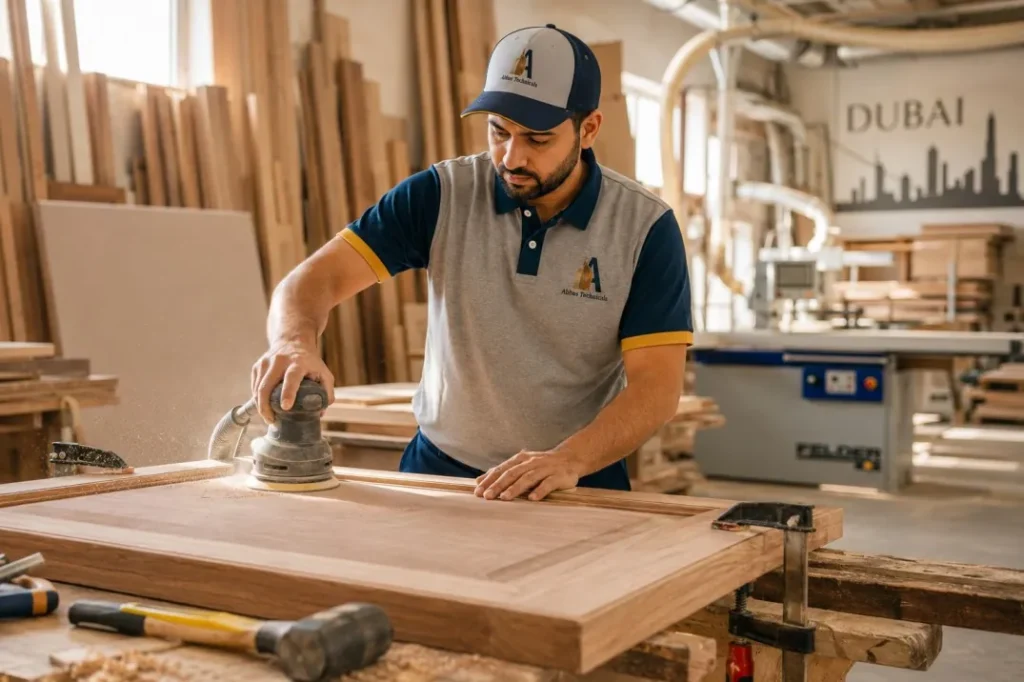
Getting the material right is only half the job — how it’s prepared and finished decides whether it survives. In our fully equipped Al Quoz workshop, our carpenters specify kiln-dried timber, acclimatise solid wood on-site before installation, use moisture-resistant grades in every wet area, and seal and edge-band panels properly so moisture can’t creep in. Every piece is finished with hard-wearing lacquers built for local conditions. With 12+ years of carpentry experience in Dubai, 25,000+ customers served, and a 4.7-star rating from 2,000+ Google reviews, we build furniture and cabinetry designed specifically to last in this climate — not off-the-shelf pieces that fail in a single summer.
Frequently Asked Questions
Is MDF or solid wood better for Dubai’s humidity?
Neither is universally better — it depends on moisture exposure. MDF is more stable against everyday humidity changes and won’t warp like solid wood, but it fails if it gets wet, so it needs moisture-resistant grades and sealed edges near water. Solid wood handles moisture well when it’s the right species and properly finished, and it’s the only option for outdoors.
Does solid wood furniture warp in Dubai?
It can, if the timber wasn’t kiln-dried or acclimatised before installation. Properly prepared and sealed solid wood from a workshop that builds for the local climate stays stable and can be refinished for decades.
Can I use MDF for kitchen cabinets in Dubai?
Yes, but only moisture-resistant MDF (MR-MDF), and never standard MDF near the sink or dishwasher. For the carcass, marine plywood is often the safer choice in a humid kitchen.
Is MDF safe to have in the home?
Yes, when you use a low-emission grade — E1, E0, or CARB-compliant — which keeps formaldehyde off-gassing within safe limits. We only use compliant board grades.
What wood is best for outdoor furniture and pergolas in Dubai?
Dense, naturally weather-resistant hardwoods like teak and iroko. MDF and standard softwoods should never be used outdoors here.
Which is cheaper, MDF or solid wood?
MDF is cheaper upfront. Solid wood costs more but lasts far longer and can be repaired, so it can work out better value over the life of the piece.
Build It Right for Dubai’s Climate
Not sure which material suits your kitchen, wardrobes, or outdoor space? Our team will recommend the right board grade or timber for every room — and build it to last.
📞 Call/WhatsApp: +971 55 310 9291
✉️ Email: booking@abbastechnical.ae
📍 Visit: 35 A Street, Al Quoz, Dubai