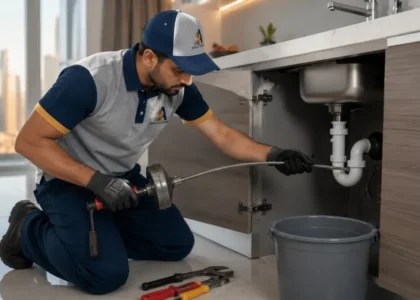



Most water leaks in Dubai homes never announce themselves. There is no puddle, no dripping tap, no burst pipe spraying across the kitchen floor. Instead, water seeps quietly behind a wall or beneath a floor slab for weeks — sometimes months — until the damage is expensive and obvious. Learning the early signs of a hidden water leak is the difference between a two-hour repair and a full bathroom rebuild.
This guide walks through the seven warning signs worth acting on, a simple 15-minute test you can run yourself using your DEWA meter, and the point at which you genuinely need professional plumbing services in Dubai rather than another week of hoping it resolves itself.
Why Hidden Water Leaks Are So Common in Dubai Homes
Dubai’s building stock creates conditions that quietly favour concealed leaks.
Almost all residential pipework here is embedded — routed inside concrete slabs, chased into block walls, or buried under screed and tile. Nothing is visible. When a joint fails, water follows the path of least resistance through the structure rather than pooling where you can see it.
The climate compounds it. Ambient temperatures above 45°C in summer drive constant expansion and contraction in supply lines, working joints loose over time. Dubai’s hard water leaves scale deposits that thin pipe walls from the inside. And in apartment towers, chilled water lines serving the air conditioning system run alongside domestic supply, adding condensation to the mix — which is why a “leak” in a Dubai Marina apartment is sometimes not a leak at all, but a failed insulation sleeve.
The single most common culprit, though, is mundane: the flexible braided hose under a sink or behind a toilet. They are rated for roughly five years. Most are never replaced.
7 Signs of a Hidden Water Leak You Shouldn’t Ignore
1. Your DEWA bill jumps without any change in usage
This is the clearest early signal. If nobody moved in, the garden irrigation did not change, and consumption climbed anyway, water is going somewhere. A pinhole leak the width of a needle can waste well over 1,000 litres a month before it produces a single visible mark. Compare the current month against the same month last year rather than against last month — seasonal irrigation and guests distort short comparisons. An unusually high DEWA bill is very often the first and only symptom.
2. You hear running water when every tap is closed
Stand in a quiet room late at night, with the AC off and every fixture closed. A faint hiss, trickle, or intermittent rush inside a wall means pressurised water is escaping. A steady hiss usually indicates a small supply-line leak. A knocking or hammering sound points to loose pipework, which is a precursor to a burst pipe rather than a leak in itself.
3. Damp patches, bubbling paint, or peeling wallpaper
Look for discolouration that has no obvious source above it. Paint that blisters or bubbles, skirting that swells, or a patch of wall that feels cooler than the surrounding surface all suggest moisture migrating through plaster. In villas, check the wall shared with a bathroom or a kitchen from both sides — the leak often shows on the dry side first.
4. A musty smell in a room that stays closed
Mould and mildew need very little moisture and no light. If a guest bedroom, a store room, or a maid’s room smells earthy or stale despite regular cleaning, something is feeding it. Trust your nose before your eyes here; the smell almost always arrives before the stain does. This matters beyond property damage — persistent damp is a respiratory irritant, particularly for children and anyone with asthma.
5. Warm spots on the floor
Walk a tiled floor barefoot in the early morning. A patch that reads noticeably warmer than the tiles around it usually means a hot water line running through the slab has failed. Plumbers call this a slab leak, and it is one of the more expensive scenarios precisely because access requires breaking floor. Catching it while the warm patch is still small is worth real money.
6. Water pressure that keeps drifting lower
A single weak shower head is a fixture problem. Pressure that declines gradually across the whole property, over weeks, is a supply problem — and a concealed leak upstream is a leading cause. If the drop is sudden rather than gradual, suspect the building’s pump or a closed valve first.
7. White chalky residue on walls or skirting
Efflorescence — a powdery white or grey crust — forms when water travels through concrete or masonry, dissolves the salts inside, and deposits them on the surface as it evaporates. On a Dubai villa’s ground floor or a basement wall, it is a reliable sign that water has been moving through the structure for a while.
How to Confirm a Leak Using Your DEWA Water Meter
Before you call anyone, run this test. It takes fifteen minutes and costs nothing.
- Turn off every water outlet. Taps, showers, washing machine, dishwasher, irrigation, water heater feed. If you have an ice maker, unplug it.
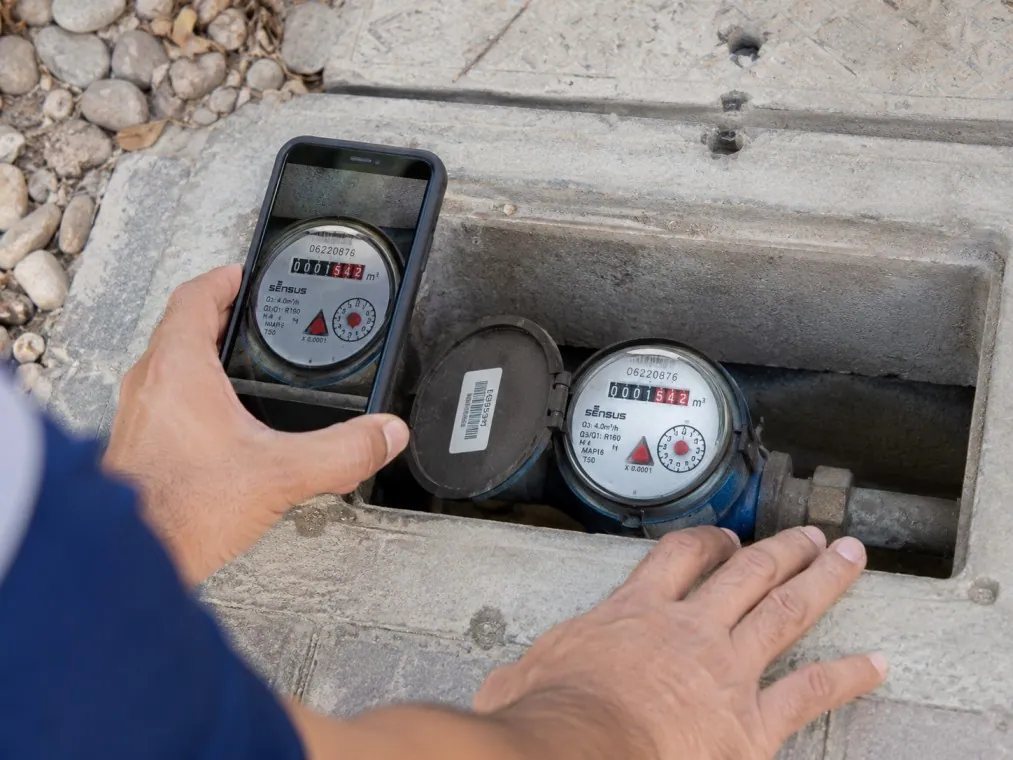
- Find your water meter. In villas it is typically in a ground-level chamber near the boundary wall. In apartments it is usually in the service riser or utility cupboard on your floor.
- Photograph the reading. Note the last digits, including the small red dial or leak indicator triangle if your meter has one.
- Wait 60 to 90 minutes. Use nothing at all during this window.
- Photograph the reading again.
If the number moved, water left your system while nothing was using it. That is a leak, and its location is somewhere between the meter and your fixtures. If the small leak-indicator triangle spins at all during the test, you have confirmation even faster.
If the reading is unchanged but your bill is still high, the problem sits upstream of your meter — that is DEWA’s or the building’s responsibility, not yours, and the meter test is your evidence.
Where Hidden Leaks Usually Hide
| Location | Typical cause | What you’ll notice first |
|---|---|---|
| Under kitchen or bathroom sink | Failed flexible braided hose | Damp cabinet base, warped MDF |
| Inside bathroom walls | Corroded joint on concealed mixer | Damp patch on the adjoining bedroom wall |
| Beneath floor slab | Hot water line failure | Warm floor spot, rising bill |
| Behind the water heater | Pressure relief valve or tank seam | Rust stain, musty cupboard |
| Toilet cistern | Perished flush valve seal | Faint constant trickle, no visible water |
| Villa garden lines | Cracked irrigation supply | Unexplained green patch, soft ground |
| Apartment AC ducting | Blocked condensate drain | Ceiling stain — often not a plumbing leak |
That last row matters. A significant share of “leaks” reported in Dubai towers are AC condensate overflows, not plumbing failures. Correctly identifying which one you have determines who pays.
What Professional Water Leak Detection in Dubai Actually Involves
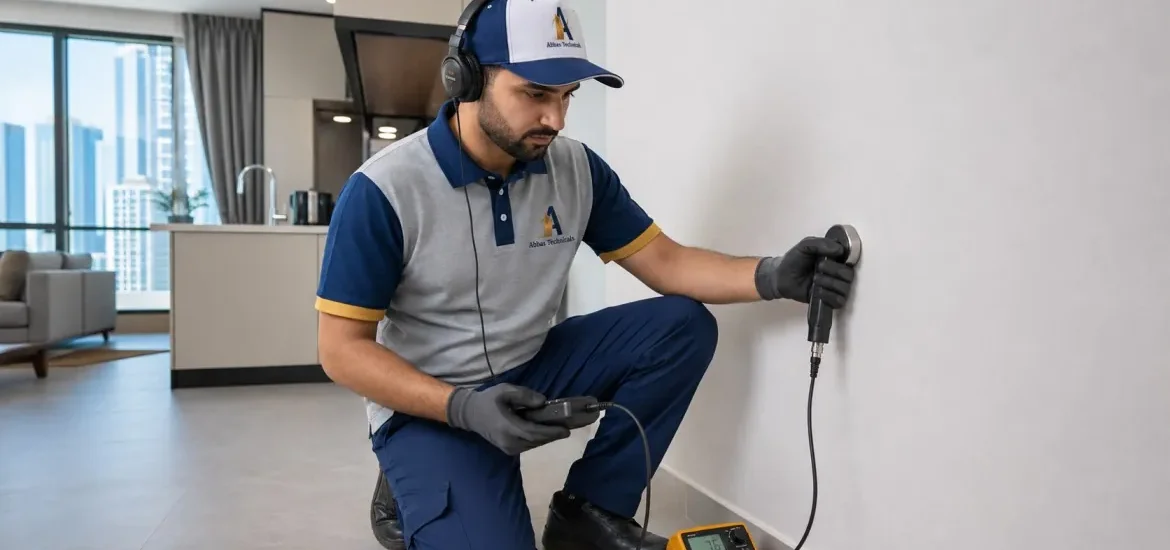
Modern leak detection is non-invasive. A competent technician should locate a leak without demolishing anything, using some combination of:
- Acoustic detection — ground microphones and amplifiers that isolate the specific frequency of water escaping a pressurised pipe, even through 200mm of concrete.
- Thermal imaging — an infrared camera that reads temperature differentials across a wall or floor, mapping the thermal footprint of escaping hot or cold water.
- Pressure testing — isolating sections of the system and pressurising them to identify which circuit is losing pressure and how fast.
- Tracer gas — introducing an inert hydrogen-nitrogen mix into the drained line and detecting where it surfaces. Used when acoustic methods fail on plastic pipework.
Anyone who arrives, glances at a damp wall, and immediately reaches for a hammer is guessing. Insist on detection before demolition. A qualified licensed Dubai plumber will pinpoint the failure to within a few centimetres and open only that section.
What it costs
Indicative ranges in the Dubai market:
| Service | Indicative range (AED) |
|---|---|
| Standard callout and inspection | 250 – 400 |
| Non-invasive detection (acoustic + thermal) | 400 – 800 |
| Slab or underground line detection | 800 – 1,500 |
| Repair after detection | From 300, depending on access |
Pricing is indicative and varies with property type, access, and pipe depth. Confirm before booking.
Set against a slab leak left running for three months — with the DEWA bill, the ruined screed, the retiling, and the mould remediation — detection is the cheapest line item in the whole exercise.
How to Prevent Hidden Water Leaks
- Replace flexible braided hoses under every sink and toilet on a five-year cycle, regardless of appearance.
- Photograph your DEWA meter on the first of each month. Two minutes a month builds a baseline that makes anomalies obvious.
- Install a pressure-reducing valve if incoming pressure exceeds 4 bar. Dubai supply frequently runs higher, and sustained over-pressure destroys joints.
- Have a plumber inspect concealed pipework whenever you undertake bathroom waterproofing and retiling — the walls are already open.
- Close your main isolation valve before any trip longer than a week.
- Service the water heater annually. Sediment build-up is what eventually splits the tank seam.
Frequently Asked Questions
How do I know if I have a hidden water leak in my Dubai home?
Run the DEWA meter test: shut off every outlet, record the meter reading, wait 60 to 90 minutes, and read it again. Any movement confirms a leak. Supporting signs of a hidden water leak include damp patches, a musty smell, warm floor spots, and a DEWA bill that rose without a change in usage.
Can a hidden water leak really increase my DEWA bill that much?
Yes. A pinhole leak on a pressurised supply line can waste more than 1,000 litres per month while producing no visible water at all. Because the loss is continuous, it compounds — most homeowners only investigate after two or three unusual billing cycles.
How much does water leak detection cost in Dubai?
Expect roughly AED 250 to 400 for a standard callout and inspection, AED 400 to 800 for non-invasive acoustic and thermal detection, and AED 800 to 1,500 for slab or underground line detection. Repairs are quoted separately once the leak is located. These figures are indicative and depend on property type and access.
Can a plumber find a water leak without breaking the walls?
In most cases, yes. Acoustic sensors, thermal imaging cameras, and pressure testing locate a concealed leak to within a few centimetres before anything is opened. Only the pinpointed section then needs access, which keeps repair and reinstatement costs down.
Who is responsible for a hidden leak — me, my landlord, or the building?
It depends on where the leak sits. Anything downstream of your water meter is generally the property owner’s responsibility, which under most Dubai tenancy contracts falls to the landlord for structural pipework. Leaks upstream of the meter belong to DEWA or the building’s owners association. Your meter test result is the evidence that settles the question.
How long does it take to find a hidden water leak?
A typical residential detection visit takes one to three hours. Slab leaks and buried garden lines take longer, particularly where the pipe route was never documented. Repair time depends entirely on access.
Book a Water Leak Inspection in Dubai
If your meter moved during the test — or if two or more of the signs above sound familiar — the leak is not going to stop on its own. Every week it runs adds to the bill and to the repair.
Abbas Technical Services has been resolving concealed leaks across Dubai, Sharjah, Ajman, and Abu Dhabi for more than a decade, with over 25,000 customers served and a 4.7-star rating from more than 2,000 Google reviews. Our technicians carry acoustic and thermal detection equipment on every callout, so the leak is located before anything is opened.