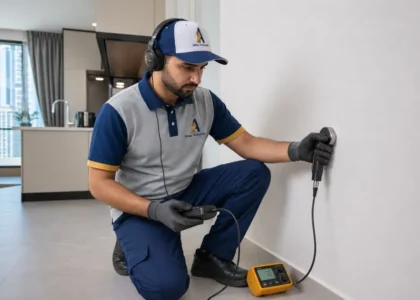



A blocked drain is one of the most common — and most avoidable — plumbing problems in Dubai homes. Water pooling around your feet in the shower, a kitchen sink that empties slowly, a gurgle from the plughole, or a faint drain smell that won’t go away: they all point to the same thing. Something is building up inside your pipes.
The good news is that most blockages have a clear cause and a fix you can do yourself. This guide covers the seven most common causes of a blocked drain in Dubai, exactly how to unblock a drain for each one, and the point where a DIY fix stops working and you need professional drain cleaning in Dubai.
Before You Start: Your DIY Drain Toolkit
A few basics clear the large majority of household blockages:
- A plunger — a cup plunger for sinks and basins, a flange plunger for toilets
- A drain snake (plumber’s auger) or a plastic zip-it strip for hair
- Baking soda and white vinegar
- Rubber gloves and a bucket
- Hot water — hot from the tap for PVC pipes; save boiling water for metal only
A quick warning about chemical drain cleaners
It is tempting to reach for a bottle of caustic drain cleaner, but resist it — especially in toilets. Many Dubai homes are fitted with PVC waste pipes, and strong caustic soda generates heat that can soften pipe joints. Worse, if the chemical does not clear the blockage, you are left with a pipe full of dangerous caustic liquid that is then hazardous for you or a plumber to deal with. Mechanical methods and a mild baking-soda-and-vinegar treatment are safer, cheaper, and usually just as effective.
The 7 Most Common Causes of a Blocked Drain in Dubai
1. Grease, fat and cooking oil
Why it happens here: Home cooking in Dubai leans heavily on oil, ghee, and fat. Poured down the sink while still warm it looks harmless, but it cools and hardens inside the pipe, catching every food particle that follows until the pipe narrows to nothing. This is the single most common kitchen blockage.
Signs: The kitchen sink drains slowly, water backs up, and there is a stale, oily smell.
How to fix it:
- Pour a kettle of hot water down the drain to soften the grease.
- Add half a cup of baking soda and leave it for 10 minutes.
- Follow with a cup of white vinegar, cover the plughole, and leave it to fizz for 20–30 minutes.
- Flush through with more hot water.
- If it is still slow, work a cup plunger over the plughole.
Prevent it: Never pour oil or fat down the sink. Let it cool, wipe pans into the bin with paper towel, and fit a sink strainer.
2. Hair and soap scum
Why it happens here: Every shower sheds hair that tangles around the drain and binds with soap scum and Dubai’s mineral-heavy water into a dense, solid mat.
Signs: Water pools around your feet in the shower; the basin drains slowly.
How to fix it:
- Remove the drain cover or stopper.
- Pull out visible hair with gloved fingers, tweezers, or a plastic zip-it strip pushed in and hooked back out.
- For a deeper clog, feed a drain snake down and twist to grab the blockage.
- Finish with baking soda, vinegar, and hot water to cut the remaining soap scum.
Prevent it: Fit a mesh hair catcher over every shower and basin drain and clear it weekly.
3. Hard-water limescale
Why it happens here: Dubai’s water is very hard. Over months and years, dissolved minerals settle onto the inside of your pipes as limescale, slowly narrowing them and giving grease and hair more to cling to. It is the invisible cause behind many “sudden” blockages.
Signs: Drainage that worsens gradually across several fixtures at once; white crusty deposits around taps and plugholes.
How to fix it:
- A monthly white-vinegar flush — a cup down each drain, left for 30 minutes — dissolves light scale.
- Heavy scale inside the pipe wall usually needs professional descaling or jetting; DIY methods cannot reach it.
Prevent it: A whole-home water softener is the real solution, and it protects your water heater and appliances at the same time.
4. Food scraps and coffee grounds
Why it happens here: Most Dubai homes have no garbage disposal unit, so anything that slips past the strainer collects in the trap. Rice, pasta, coffee grounds, and tea leaves are the worst offenders — they clump together and do not break down.
Signs: A slow kitchen sink, gurgling, and a food odour.
How to fix it:
- Block the overflow, then plunge the sink firmly with a cup plunger.
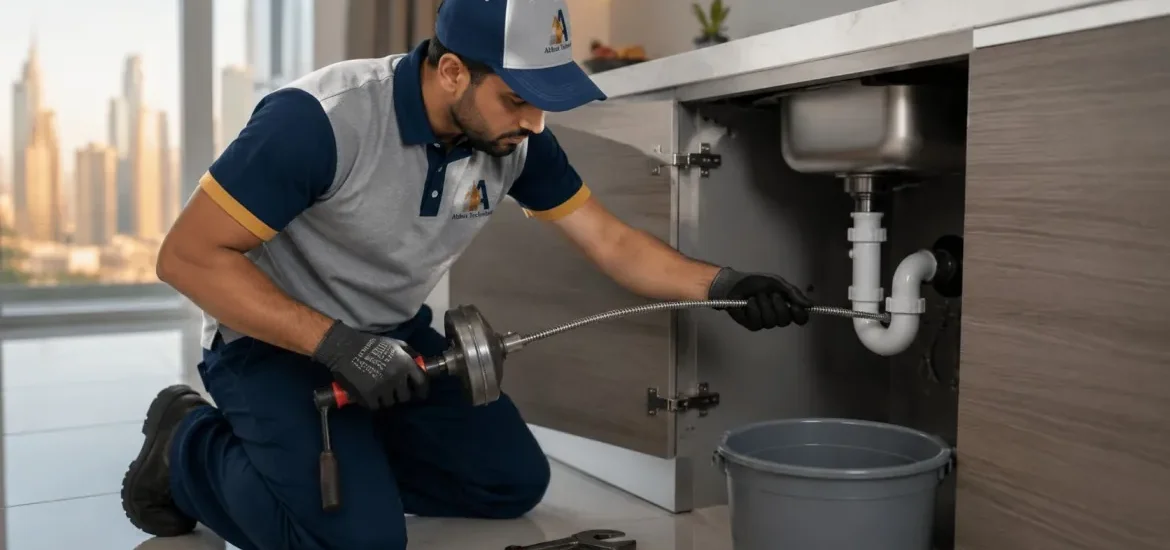
- If that fails, put a bucket under the sink, unscrew the U-bend (the P-trap), and clear it by hand — this is exactly where scraps collect.
- Reassemble and flush with hot water.
Prevent it: Scrape plates into the bin, never the sink, and always use a sink strainer.
5. Wet wipes and sanitary products
Why it happens here: “Flushable” wipes are the biggest myth in plumbing. They do not break down the way toilet paper does, and they are a leading cause of blocked toilets and sewer blockages across Dubai. Sanitary products, cotton pads, and kitchen roll behave the same way.
Signs: Toilet water rises high, then drains very slowly — or will not clear at all.
How to fix it:
- Use a flange (toilet) plunger with firm, steady strokes rather than hard splashing.
- If plunging fails, use a toilet auger, winding it in to hook or break up the blockage.
- Never use a chemical cleaner in a toilet — it will not shift a solid mass and it makes the standing water hazardous.
Prevent it: Flush nothing but the “3 Ps” — pee, poo, and paper. Keep a bin in every bathroom.
6. Sand, dust and grit
Why it happens here: This cause is unique to the region. Fine desert sand and construction dust get tracked indoors and washed into floor drains, balcony drains, and ground-floor gullies, where they settle and compact into a near-cement layer — especially near ongoing building work.
Signs: Outdoor, balcony, or bathroom floor drains overflow or drain slowly, with a gritty residue around the grate.
How to fix it:
- Lift the drain grate and scoop out the visible sand and silt.
- Flush with a strong flow of water to move the rest along.
- Compacted grit deeper in the line needs a plumber’s rods or jetting.
Prevent it: Keep drain grates in place, sweep balconies before washing them down, and rinse sandy feet outside where you can.
7. Foreign objects and root intrusion
Why it happens here: Small objects — children’s toys, cotton buds, jewellery, bottle caps — lodge in traps and bends. And in villas with gardens, tree and shrub roots seek out moisture and infiltrate outdoor drainage lines through tiny joints, then grow into a mesh that catches everything passing through.
Signs: A sudden, complete blockage right after something went down the drain; or, for roots, an outdoor blockage that keeps returning after you clear it.
How to fix it:
- Retrieve a visible object near the plughole — do not push it deeper.
- For an object in the trap, remove and empty the U-bend.
- Root intrusion is not a DIY job. It needs a CCTV drain survey to find the entry point and mechanical rodding or cutting to clear it.
Prevent it: Fit drain guards, and in villas with mature planting nearby, have outdoor drains inspected periodically.
Which Drain Is Blocked? A Quick Diagnosis
| What you notice | Likely cause | Which drain |
|---|---|---|
| Kitchen sink slow, oily smell | Grease + food scraps | Kitchen |
| Water pools in the shower | Hair + soap + scale | Bathroom |
| Toilet rises then drains slowly | Wet wipes / sanitary products | Toilet |
| Several drains gurgle at once | Main sewer line | Whole house — call a pro |
| Balcony or floor drain overflows | Sand + grit | External |
When to Stop and Call a Professional
Some blockages are past the point a plunger can help. Stop the DIY and call a plumber if:
- More than one fixture is blocked at the same time — a sink, toilet, and shower all backing up points to the main sewer line, not a single drain.
- Using one fixture affects another — the shower gurgles or fills when the washing machine drains, or the toilet bubbles when you run the sink. That cross-fixture backup is a classic main-line blockage.
- There is a sewage smell, or water is backing up onto the floor.
- The blockage keeps returning within days of being cleared.
- You have already tried a plunger and a hand auger and nothing has shifted.
Any of these means the problem sits deeper than a household tool can reach. At that point a licensed Dubai plumber will clear it properly rather than push it further down the line.
What Professional Drain Cleaning in Dubai Involves
A professional does not just use a bigger plunger. Depending on the blockage, expect:
- A motorised drain machine (electric eel) — a powered rotating cable that cuts through dense blockages and roots a hand snake cannot.
- High-pressure water jetting — scours the full diameter of the pipe clean, clearing the grease and scale that a snake leaves behind on the pipe walls.
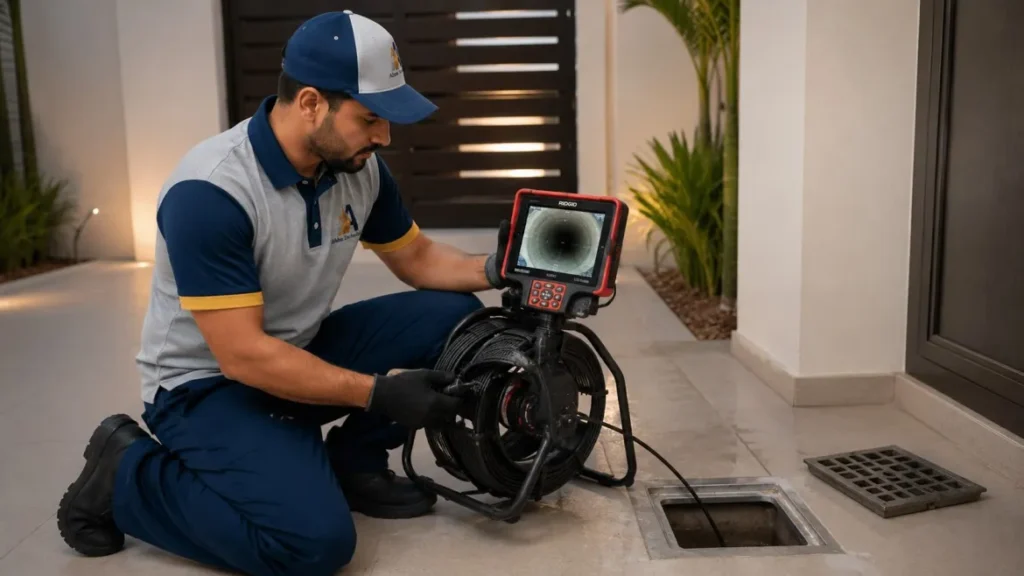
- A CCTV drain survey — a camera fed into the line locates the exact blockage and reveals any pipe damage or root ingress, so nothing is guesswork.
- Rodding — jointed rods for accessible external drains and gullies.
Drain cleaning cost in Dubai
Indicative ranges in the Dubai market:
| Service | Indicative range (AED) |
|---|---|
| Single sink or basin unblocking | 150 – 300 |
| Toilet unblocking | 200 – 350 |
| Main line clearing / water jetting | 400 – 800 |
| CCTV drain survey | 300 – 600 |
Pricing is indicative and varies with access and severity. Confirm before booking.
How to Prevent Blocked Drains
Most blockages never happen if you:
- Keep grease, fat, and oil out of the sink entirely.
- Fit strainers on kitchen sinks and mesh catchers on every shower and basin.
- Flush only the 3 Ps down the toilet — never wipes, even “flushable” ones.
- Give each drain a monthly baking-soda-and-vinegar flush to keep grease and scale from building up.
- Consider a water softener to stop limescale at the source.
One last note: standing water from a chronic blockage can mask a separate problem. If you also notice damp patches or a musty smell that does not clear once the drain is running again, check for a hidden water leak as well — the two are easy to confuse.
Frequently Asked Questions
How do I unblock a drain in Dubai?
Start mechanically: for sinks and showers, remove the cover, clear visible debris, then use a plunger or drain snake. For grease or scale, pour hot water followed by baking soda and white vinegar, leave it 20–30 minutes, and flush. Avoid chemical cleaners, especially in toilets. If the blockage affects more than one fixture or keeps returning, it is likely in the main line and needs a professional.
Why does my drain keep getting blocked?
Recurring blockages usually mean the underlying build-up was never fully cleared, or there is a deeper issue — heavy limescale narrowing the pipe, grease coating the walls, or root intrusion in an outdoor line. A one-off plunge treats the symptom; a professional drain jet or CCTV survey finds and removes the actual cause.
Are chemical drain cleaners safe to use?
They carry real risks, particularly in the PVC pipes common in Dubai homes. Caustic cleaners generate heat that can damage pipe joints, and if they fail to clear the blockage they leave a pipe full of hazardous liquid. They should never be used in a toilet. Mechanical methods and mild baking-soda-and-vinegar treatments are safer and usually just as effective.
How much does drain cleaning cost in Dubai?
Expect roughly AED 150 to 300 to unblock a single sink or basin, AED 200 to 350 for a toilet, and AED 400 to 800 for main-line clearing or water jetting. A CCTV drain survey typically runs AED 300 to 600. Figures are indicative and depend on access and how severe the blockage is.
Can a blocked drain cause a bad smell?
Yes. Trapped food, grease, and organic matter decompose inside the pipe and produce a foul odour, and a partial blockage can disturb the water seal in the trap that normally keeps sewer gas out. Clearing the blockage and flushing the drain usually resolves the smell; if it persists, the trap or venting may need checking.
When should I call a plumber for a blocked drain?
Call a plumber when several fixtures back up at once, when using one fixture makes another gurgle or overflow, when there is a sewage smell or water on the floor, or when a blockage returns soon after you clear it. These point to a main-line or structural issue that household tools cannot reach.
Book a Drain Cleaning Visit in Dubai
If you have worked through the fixes above and the drain still will not clear — or if more than one fixture is affected — the blockage is deeper than a plunger can reach, and forcing it risks pushing it further down the line.
Abbas Technical Services clears blocked drains across Dubai, Sharjah, Ajman, and Abu Dhabi, with over 25,000 customers served and a 4.7-star rating from more than 2,000 Google reviews. Our plumbers carry motorised drain machines, jetting equipment, and CCTV survey cameras, so the blockage is located and cleared properly the first time.
Book a drain cleaning visit or reach us directly:
📞 +971 55 310 9291 ✉️ booking@abbastechnical.ae 📍 35 A Street, Al Quoz, Dubai