


Updated September 2026
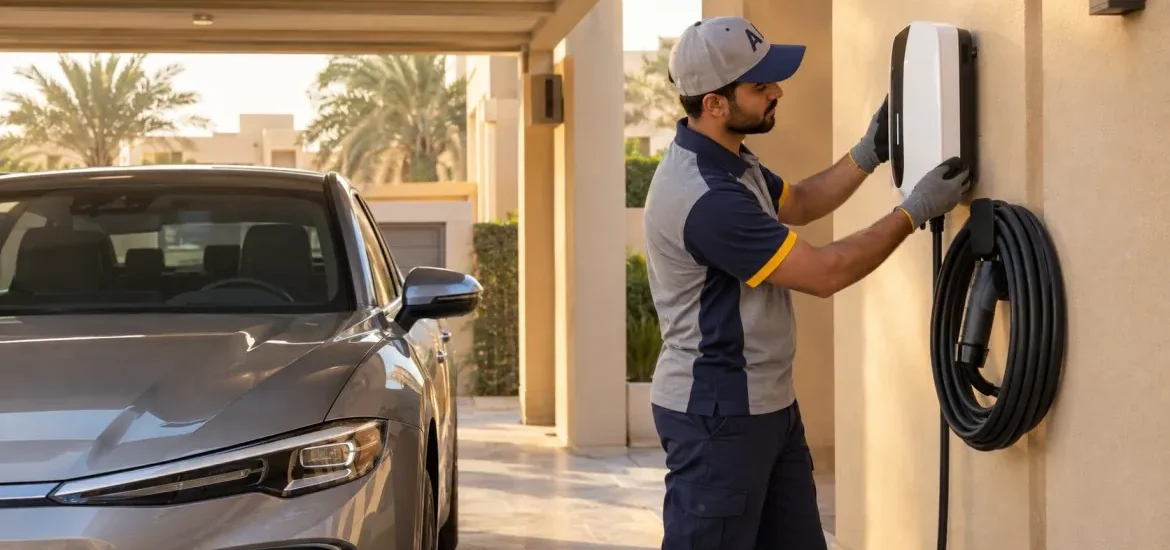
Charging at home is the cheapest and most convenient way to run an electric car in Dubai, but home EV charger installation in Dubai is not a plug-and-go job. DEWA requires approval for private chargers, the equipment has to meet its technical rules, and your wiring has to carry a heavy load for hours at a time. This guide covers the rules, what it costs to install and run a home charger, how the process works in villas and apartments, and what to check before you book an installer.
Quick answer: Home EV chargers in Dubai need DEWA approval and must meet DEWA’s EV Charging Technical Regulations, including installation to BS 7671 and the IET Code of Practice. Most homes use a 7 kW single-phase or 11 kW three-phase wall box. Charging at home costs AED 0.29 to 0.44 per kWh before VAT, compared with AED 0.70 on public AC chargers.
Do You Need DEWA Approval to Install an EV Charger at Home?
Yes. DEWA’s EV Charging Infrastructure Regulation (Version 1.3, November 2025) says anyone installing private charging equipment at their premises must follow DEWA’s procedures to obtain approval. They must also comply with its technical regulations. DEWA’s technical regulations direct owners to start the connection process through a DEWA-enrolled consultant or contractor.
Two more rules are worth knowing:
- Your charger is for your household only. It can only supply the household on the DEWA account it’s connected to. Using it to charge the public or third parties is forbidden.
- No extension cords. DEWA restricts charging through extension cords on safety grounds, because they can overheat and cause electrical faults.
In practice, that means choosing an installer on DEWA’s enrolled contractor list who handles the approval for you.
Which Home EV Charger Is Right for You?
Charger size depends on two things: the electricity supply to your home and the maximum AC charging rate your car accepts. A bigger wall box won’t charge faster than your car’s onboard charger allows.
| Charger | الأفضل | 10–80% top-up, 60 kWh battery |
|---|---|---|
| 7 kW single-phase | Most apartments and townhouses | About 6 hours |
| 11 kW three-phase | Villas with three-phase supply and cars that accept 11 kW AC | About 4 hours |
| 22 kW three-phase | DEWA’s maximum for one AC charge point; few cars accept it, so rarely worth it at home | About 2 hours where supported |
Whatever size you choose, check the charger against DEWA’s specifications:
- A Type 2 connector
- IP54 and IK10 protection or better
- Rated to operate at 55°C ambient temperature
- A 30 mA Type A residual current device
Chargers must also comply with the relevant IEC standards.
How Much Does Home EV Charger Installation Cost in Dubai?
The total depends on several things:
- The charger itself
- The cable distance from your distribution board to the parking spot
- Whether the board has spare capacity or needs upgrading
- Single-phase versus three-phase work
- Any trenching or conduit
- Building requirements in apartments
As a rough guide, installers in Dubai commonly advertise labour for a simple townhouse or villa installation from around AED 800 to 1,000. The wall box itself adds roughly AED 2,000 or more. Long cable runs, board upgrades and three-phase work push the total higher. Always ask for an itemised quote that separates the charger, cable, protection devices, civil work, labour and approval fees.
How Much Does It Cost to Charge an EV at Home in Dubai?
Home charging is billed on your normal DEWA account. Residential electricity uses a slab tariff based on your total monthly consumption, plus a fuel surcharge (AED 0.06 per kWh in September 2026) and 5% VAT.
| Monthly household use | Rate incl. fuel surcharge (before VAT) |
|---|---|
| 0–2,000 kWh | AED 0.29/kWh |
| 2,001–4,000 kWh | AED 0.34/kWh |
| 4,001–6,000 kWh | AED 0.38/kWh |
| Above 6,000 kWh | AED 0.44/kWh |
For comparison, DEWA’s regulation sets public charging at AED 0.70 per kWh for AC and AED 1.20 per kWh for DC, plus VAT. A 40 kWh top-up costs roughly AED 11.60 to 17.60 at home, AED 28 on a public AC charger and AED 48 on a DC fast charger, before VAT.
Two things catch people out:
- Charging can raise your slab. EV charging adds to your monthly total, so it can push your household into a higher slab, especially in summer when AC use is high.
- Night charging isn’t cheaper. The tariff is based on monthly consumption rather than time of day, so charging overnight doesn’t lower your rate.
How Home EV Charger Installation Works, Step by Step
- Check your car and supply. Confirm your car’s maximum AC charging rate and whether your home has single-phase or three-phase power.
- Book a site survey. The installer assesses spare capacity on your distribution board, plans the cable route and agrees the mounting position.
- Get building or community approval. Apartments and some villa communities require written permission before work starts.
- Obtain DEWA approval. Your DEWA-enrolled installer follows DEWA’s procedures for private charging equipment.
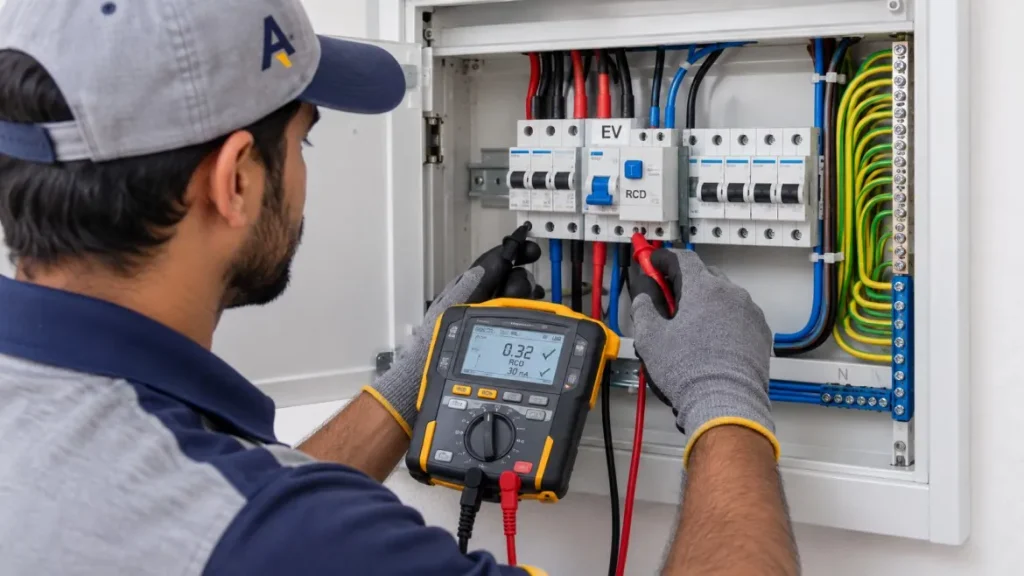
- Install the circuit and charger. A dedicated circuit runs from the board with the correct breaker, RCD and earthing, in proper cable containment.
- Test and commission. The installer tests the circuit and charger and hands over the test results.
Installing an EV Charger in a Dubai Apartment
Apartment installations follow the same rules, with extra steps:
- Get written approval from building management or the owners association before any work in shared parking.
- Make sure the charger connects to your own DEWA account. That can be a cable from your unit’s board or a metered arrangement agreed with the building.
- Ask whether the building already offers managed charging. Under DEWA’s regulation, a charger on the building’s supply that serves several residents counts as public charging and needs a licensed charge point operator.
- Expect higher costs where the cable has to run a long way through the car park.
Is Your Home’s Wiring Ready for an EV Charger?
A 7 kW charger draws 32 amps continuously for hours, more than almost any other appliance in your home. Get your electrical system checked first if you notice any of these:
- No spare ways on your distribution board, or an old fuse-type board.
- Breakers that trip when the AC, oven and water heater run together.
- Warm sockets, flickering lights or a burning smell.
- Original wiring in an older villa.
Upgrading the board or wiring before the charger goes in is cheaper than fixing a failed installation. Our guides to distribution board upgrades and signs you need to rewire your Dubai home explain what to look for.
How to Choose an EV Charger Installer in Dubai
Before you book, confirm the installer:
- Appears on DEWA’s enrolled consultant and contractor listing.
- Carries out a load assessment before quoting.
- Gives an itemised quote, not a single lump sum.
- Installs to BS 7671 and the IET Code of Practice, and hands over test results.
- Supplies a charger that meets DEWA’s specifications.
- Handles building approval and DEWA paperwork for you.
Abbas Technical Services’ electricians can check your home’s supply, upgrade your distribution board or wiring where needed, and get your property ready for a safe, compliant charger installation.
Abbas Technical Services is a DEWA-enrolled contractor, so our electricians can assess your home, install your charger and handle the DEWA approval from start to finish.
الأسئلة المتكررة
Do I need DEWA approval to install an EV charger at home in Dubai?
Yes. DEWA’s EV Charging Infrastructure Regulation requires anyone installing private charging equipment to follow DEWA’s approval procedures and meet its technical regulations. DEWA directs owners to start the process through a DEWA-enrolled consultant or contractor.
How much does it cost to charge an EV at home in Dubai?
Home charging is billed at DEWA’s residential slab tariff plus the fuel surcharge, which works out at AED 0.29 to 0.44 per kWh before 5% VAT. Public AC chargers cost AED 0.70 per kWh and DC fast chargers AED 1.20 per kWh, plus VAT.
Is charging an EV at night cheaper in Dubai?
No. DEWA’s residential tariff is based on your total monthly consumption, not the time of day, so the rate is the same whenever you charge. Heavy charging can, however, push your monthly total into a higher slab.
Can I charge my EV from a normal wall socket?
DEWA restricts charging through extension cords on safety grounds, and a standard socket is not designed for hours of continuous high load. A dedicated wall box on its own circuit is the safer option for daily charging.
Can I install an EV charger in my apartment in Dubai?
Usually, yes. You need written approval from building management or the owners association, and the charger must connect to your own DEWA account. Some buildings already provide managed charging through a licensed operator.
Should I choose a 7 kW or 11 kW home charger?
A 7 kW single-phase charger suits most apartments and townhouses. An 11 kW charger only charges faster if your home has three-phase power and your car accepts 11 kW AC charging.