


Your AC is running. The fan is spinning. But the room is still hot. If your AC is not cooling properly in Dubai — especially during peak summer — you are not alone. This is the most common complaint our technicians receive between May and September.
The good news: most causes are fixable quickly. Some you can sort yourself in minutes. Others need a certified technician. This guide walks you through all 8 causes, how to spot each one, and exactly what to do next — so you are not sitting in the heat longer than necessary.
Quick Answer: Why Is My AC Not Cooling?
Before we go into detail, here is the short version:
| Cause | DIY Fix? | Urgency |
|---|---|---|
| Dirty or blocked air filter | ✅ Yes | Low |
| Low refrigerant (gas) | ❌ No | High |
| Dirty evaporator or condenser coil | ❌ No | Medium |
| Thermostat set incorrectly | ✅ Yes | Low |
| Blocked or leaking air ducts | ❌ No | Medium |
| Faulty or frozen compressor | ❌ No | High |
| Undersized AC for the room | ❌ No | Medium |
| Dirty or blocked outdoor unit | ⚠️ Partially | Medium |
1. Dirty or Blocked Air Filter — The Most Common Cause
What happens: The air filter traps dust and debris before it enters the AC system. In Dubai’s dusty environment, filters clog faster than anywhere else — sometimes within 2–4 weeks during sandstorm season. A blocked filter restricts airflow, so even if your AC is working perfectly, cold air cannot circulate into the room.
How to spot it: Remove the filter panel (usually a grille on the indoor unit). If the filter looks grey and thick with dust, that is your problem.
What to do: Clean the filter with warm water and a soft brush. Let it dry completely before reinstalling. This takes 15 minutes and costs nothing. If it has not been cleaned in months, replace it entirely.
When to call a technician: If cleaning the filter does not restore cooling within 30 minutes, the blockage has likely caused ice buildup on the coil — a technician needs to thaw and inspect the system.
2. Low Refrigerant (Gas) — The Most Misunderstood Cause
What happens: Refrigerant is the substance that actually makes your AC cool air. When levels drop — usually because of a slow leak — the system loses its ability to transfer heat. Your AC runs constantly but the air coming out is barely cool.
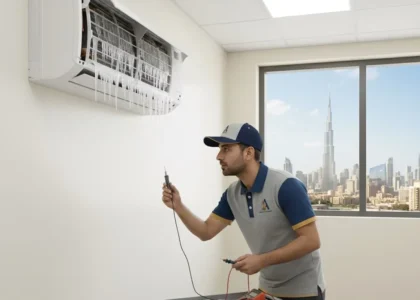
How to spot it: The air from your vents feels slightly cool rather than cold. The outdoor unit may make a hissing or bubbling sound. You might also notice ice forming on the copper pipes.
What to do: This is not a DIY fix. Refrigerant handling requires certification and specialist equipment. Call a technician immediately — continuing to run an AC with low gas puts serious strain on the compressor, which is the most expensive component to replace.
Important: Topping up the gas without fixing the leak is a temporary solution. A proper repair involves finding and sealing the leak first, then recharging the system to the correct level.
3. Dirty Evaporator or Condenser Coil
What happens: The evaporator coil (inside the unit) absorbs heat from the air. The condenser coil (in the outdoor unit) releases that heat outside. When either coil is coated in dust or dirt, heat transfer is blocked — and your AC loses most of its cooling ability.
How to spot it: The indoor unit may drip excess water. The room takes much longer than usual to cool. You may notice a musty smell when the AC runs.
What to do: Coil cleaning requires professional equipment — a high-pressure coil cleaner and the right chemical treatment. Annual AC servicing covers this as standard. If your last service was more than 12 months ago, a dirty coil is a likely culprit.
4. Thermostat Set Incorrectly — Easy to Overlook
What happens: This sounds obvious, but it is surprisingly common. The thermostat may be set to “fan only” mode (which circulates air without cooling it), or the temperature setting may be higher than the room temperature. Some remote controls also have a “dry” or “heat” mode that gets accidentally activated.
How to spot it: Check your remote. Make sure it shows the snowflake icon (cool mode), not the fan or sun icon. Make sure the set temperature is lower than the current room temperature.
What to do: Switch to “cool” mode, set the temperature to 22–24°C, and wait 5 minutes. If airflow resumes and air feels cold, problem solved. If the thermostat itself is faulty — displaying wrong temperatures or not responding — a technician can replace or recalibrate it quickly.
5. Blocked or Leaking Air Ducts (Ducted Systems)
What happens: In ducted or central AC systems, cooled air travels through a network of ducts to reach each room. If a duct is blocked by debris, has a gap, or has partially collapsed, cool air never reaches its destination — even though the unit is producing it perfectly.
How to spot it: Some rooms are much cooler than others. You can feel strong airflow at the unit but weak airflow at the vents. Ducts that have not been cleaned in 2–3 years are a likely suspect in Dubai’s dusty environment.
What to do: Do not attempt to inspect ducts yourself — accessing them without the right equipment can cause damage. Book a duct inspection and cleaning with an AC specialist. This is also a significant indoor air quality issue, as blocked ducts accumulate mould, bacteria, and allergens.
6. Faulty or Frozen Compressor
What happens: The compressor is the engine of your AC system — it circulates the refrigerant through the coils. If the compressor is failing, the AC will run but produce little to no cooling. A frozen compressor (caused by running the AC with low refrigerant for too long) is one of the most common serious faults we see in Dubai.
How to spot it: The outdoor unit is running loudly or making clicking/grinding sounds. The AC runs but the room never reaches the set temperature even after hours. The system short-cycles — turning on and off every few minutes.
What to do: Turn off the AC completely and call a technician. Running a failing compressor does more damage and increases repair costs significantly. Do not keep restarting the unit hoping it will fix itself.
7. AC Unit Is Too Small for the Room
What happens: In Dubai, room size, ceiling height, sun exposure, and the number of people in a space all affect how much cooling capacity is needed. A 1-tonne split unit simply cannot cool a 30m² living room in 45°C heat. If the AC runs constantly without ever reaching the set temperature, capacity mismatch is worth investigating.
How to spot it: The AC has always struggled to cool the room — this is not a sudden change. It runs non-stop in summer. The room nearest the outdoor sun-facing wall is always hotter.
What to do: An AC specialist can calculate the correct BTU/tonnage for your room and advise on whether your unit is undersized. In some cases, improving insulation or adding window film can help a borderline unit perform better without replacing it.
8. Dirty or Blocked Outdoor Unit
What happens: The outdoor condenser unit needs clear airflow to release heat outside. In Dubai, sand, dust, leaves, and debris accumulate on the unit’s fins rapidly. If airflow is restricted, the system cannot expel heat efficiently — and cooling performance drops.
How to spot it: The outdoor unit looks visibly dirty, or objects have been placed near it blocking airflow. The unit runs but feels excessively hot to the touch even on the inlet side.
What to do: Keep a 50cm clearance around the outdoor unit at all times. You can gently rinse the fins with a low-pressure hose to remove loose dust. For a deep clean of the fins and internal components, include the outdoor unit in your annual AC service.
When to Call a Technician Immediately
Do not wait if you notice any of the following alongside poor cooling:
- 🔴 Ice forming on the copper pipes or indoor unit
- 🔴 Burning smell from the indoor or outdoor unit
- 🔴 Loud banging, grinding, or hissing sounds
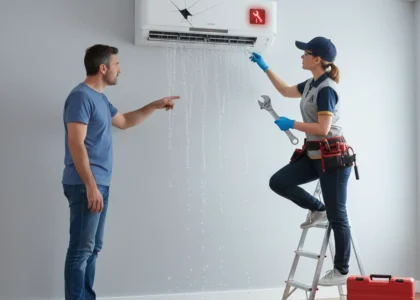
- 🔴 Water leaking heavily from the indoor unit
- 🔴 The circuit breaker trips when the AC starts
These are signs of a serious fault. Continuing to run the AC risks damaging the compressor — and a compressor replacement costs 5–10x more than a standard repair.
How to Prevent Your AC from Stopping Cooling in Dubai
The most effective prevention is simple: service your AC twice a year. Before summer (April–May) and mid-season (August) are the optimal times in Dubai’s climate. A professional service catches low gas levels, dirty coils, and drainage issues before they cause a breakdown.
For landlords and property managers running multiple units, an Annual Maintenance Contract (AMC) with Abbas Technical covers all scheduled services, priority emergency response, and discounted repairs — at a fixed annual cost with no surprise invoices.
AC Still Not Cooling After Checking Everything?
If you have worked through this list and your AC is still not cooling properly, the issue is likely inside the unit — a refrigerant leak, a coil problem, or a compressor fault — and needs a certified technician to diagnose correctly.
Abbas Technical provides same-day AC repair and maintenance across Dubai, including Jumeirah, Al Barsha, Business Bay, Downtown, Deira, JVC, Motor City, and Al Quoz. Our certified AC specialists carry the most common parts on every van, so most faults are resolved in a single visit.
Frequently Asked Questions
The most common causes are a dirty filter, low refrigerant gas, or a dirty evaporator coil. Check and clean the filter first — if that does not resolve it within 30 minutes, call a technician to inspect the refrigerant level and coil condition.
Minor repairs like a refrigerant top-up cost AED 150–300. Coil cleaning is typically AED 200–400 per unit. Compressor replacements range from AED 800–2,500+ depending on the brand and unit size. Abbas Technical provides a written quote before starting any work.
No. Refrigerant handling requires a certified technician and specialist equipment. Attempting to handle refrigerant without certification is illegal in the UAE and can cause serious injury.
Most AC repairs in Dubai are completed in 1–2 hours on the first visit. Compressor replacements or duct repairs may take longer and require a follow-up visit if parts need to be sourced.
If the AC is under 8 years old, repair is almost always more cost-effective. If the compressor has failed on a unit older than 10 years, replacement is usually the better investment — newer units are significantly more energy-efficient and will reduce your DEWA bills.